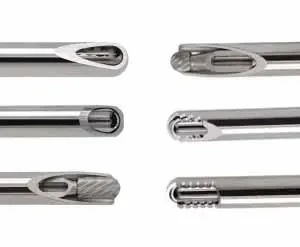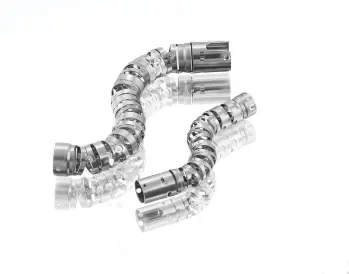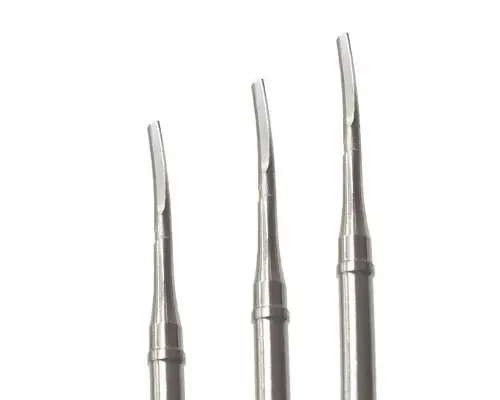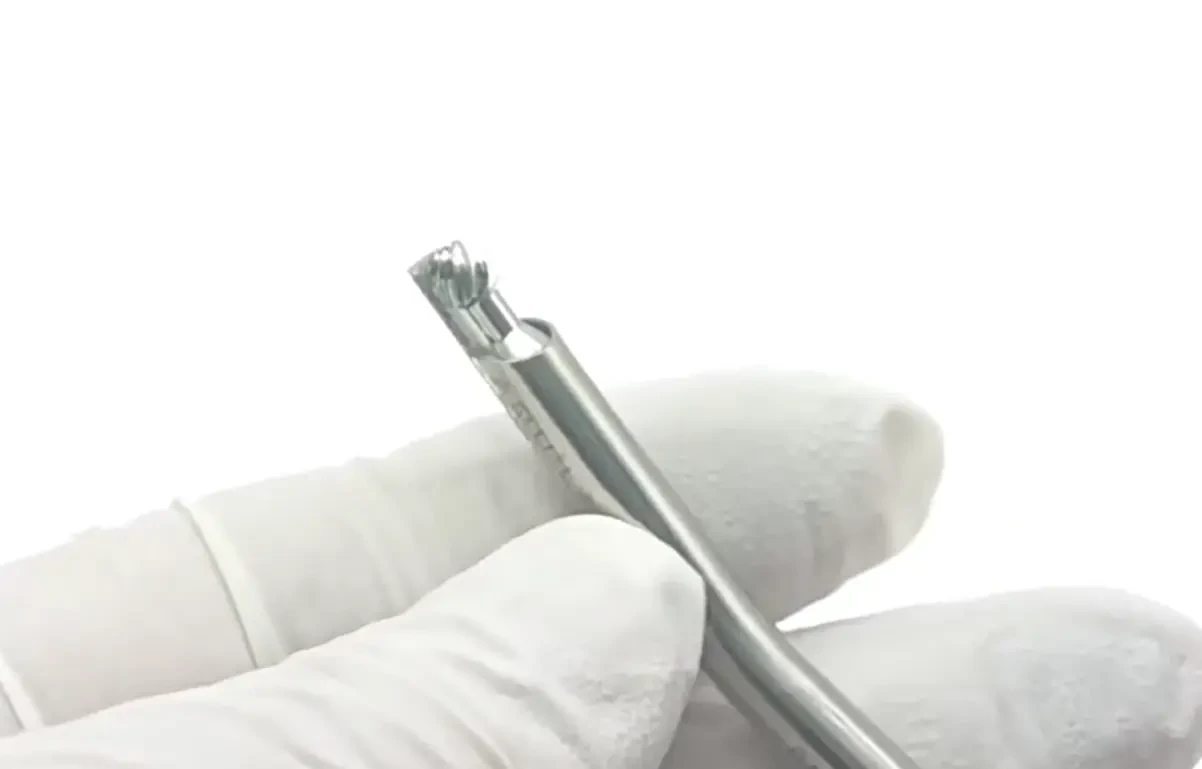
Arthroscopic shaver blades and rotary burrs are small, high-speed cutting parts inside minimally invasive joint systems. Many engineers underestimate how tight the tolerance window is for cutting edges, because minor defects will directly change cutting performance and device safety.
We mostly work with 440C and 316L stainless steel for these components. 440C holds a sharp edge better after heat treatment, which is why it is widely used for shaver blades and cutting burrs. The downside is its corrosion resistance is lower than 316L, so it needs proper passivation after machining. 316L is more stable for repeated sterilization, but it is harder to maintain a consistent sharp cutting edge at high rotational speeds. We walk clients through this trade-off early, rather than simply picking a material by default.
Edge burr removal is one of the hardest steps. Manual deburring is inconsistent and hard to document for medical batches. We combine precision EDM and controlled micro-finishing processes to get clean, repeatable cutting profiles. Any leftover micro-burr risks detachment during surgery, which is a non-negotiable failure point for medical device audits.
Runout tolerance is another key parameter. When the burr spins at high RPM inside the handpiece, excessive runout will cause vibration, uneven cutting and faster wear of both the burr and the host shaver system. We check runout for sampled parts in every batch, and record all inspection data alongside dimensional reports.
We also align our surface finish with the customer’s packaging and sterilization workflow. Some clients require a low Ra finish to reduce protein adhesion after use. The finish requirement must be matched with the cleaning process in the cleanroom after machining.
We produce custom shaver blades and burrs for OEM arthroscopic systems, supporting drawing-based custom development. Reach out with your specifications if you need prototype or volume production.
Paragraph 5 · Inside The Cleanroom From Machining To Packing
Paragraph 6 · Inside The Cleanroom From Machining To Packing
Paragraph 7 · Inside The Cleanroom From Machining To Packing
Paragraph 8 · Inside The Cleanroom From Machining To Packing