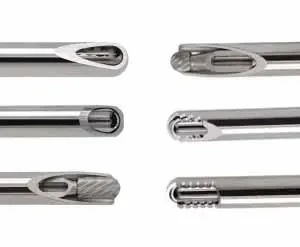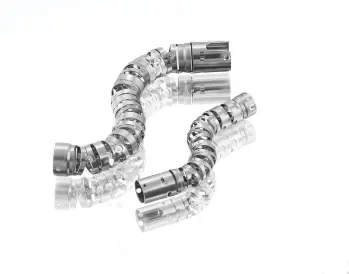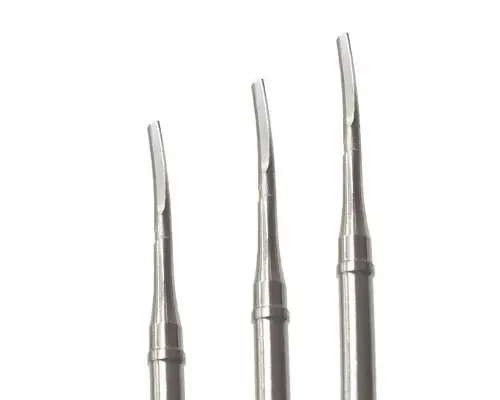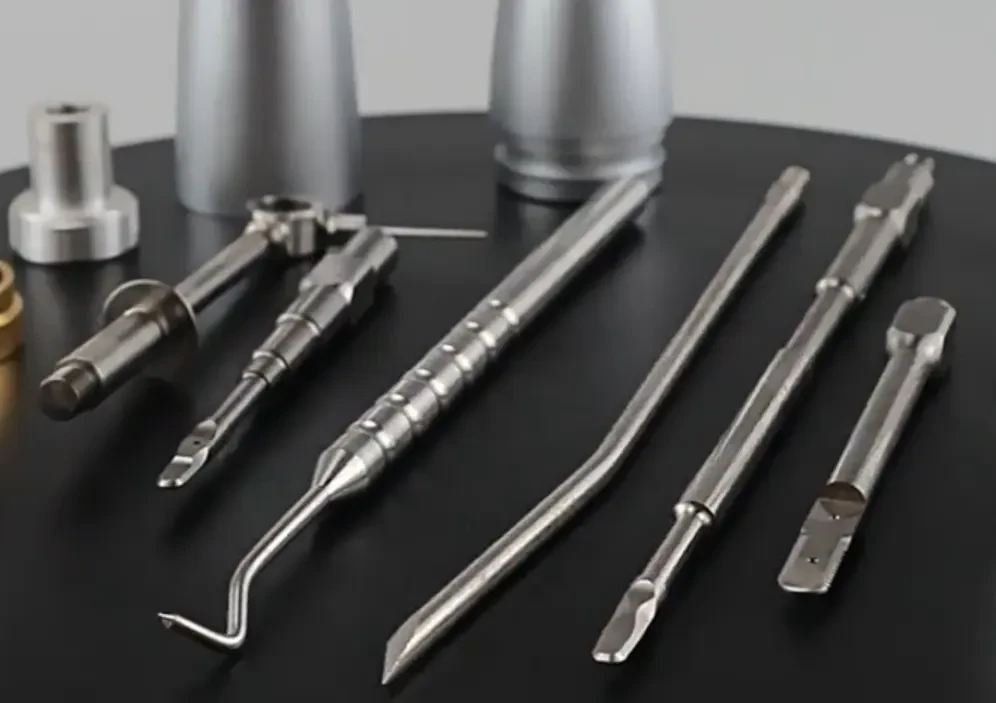
Surgical ultrasonic horns (sonotrodes) transmit high-frequency vibration from the transducer to tissue. A lot of customers assume the geometry on the drawing alone will hit the target resonant frequency, but real production often brings unexpected shifts.
Ti‑6Al‑4V ELI is the dominant material for this component. It has good acoustic transmission performance and acceptable fatigue resistance under cyclic vibration. Ordinary titanium alloy cannot replace ELI grade here; impurity levels directly affect damping characteristics and service life. Even with the same CAD drawing, raw material batch variation can shift resonance frequency slightly.
Machining stability is critical. Ultrasonic horns are usually milled on high-speed precision machines. Small differences in material removal rate, surface stress and post-processing will change the vibration node position. We do not rely only on CAD simulation. After machining each prototype, we test its actual resonant frequency and amplitude, and feed measurement data back to adjust the machining program.
The connection interface is another common pain point. The thread or flange joint between horn and transducer is where energy loss often happens. Poor contact will create heat, reduce output amplitude and accelerate fatigue cracking at the root. We keep strict control on the flatness and perpendicularity of mating surfaces, and document every frequency test result for traceability.
Some customers ask for surface coating. Coatings can improve wear resistance, but almost every coating will alter acoustic properties. We always warn customers to run frequency validation after coating, rather than assuming the pre-coating test result still applies. This is a mistake we have seen multiple times in new product development.
Process documentation is non-negotiable for ISO13485 traceability. Every weld program, gas setting, batch material certificate and inspection record is logged together. If a customer’s lab flags a weld failure during their device validation, we can trace back to raw material lot, fixturing version and the exact parameter set used on that production run.
Laser welding opens up design options for miniature medical assemblies that older joining methods cannot deliver. But it is a process that depends just as heavily on machining quality, surface cleanliness and fixture design as it does on laser output.
Paragraph 6 · Three Utility Model Patents Granted
Paragraph 7 · Three Utility Model Patents Granted
Paragraph 8 · Three Utility Model Patents Granted